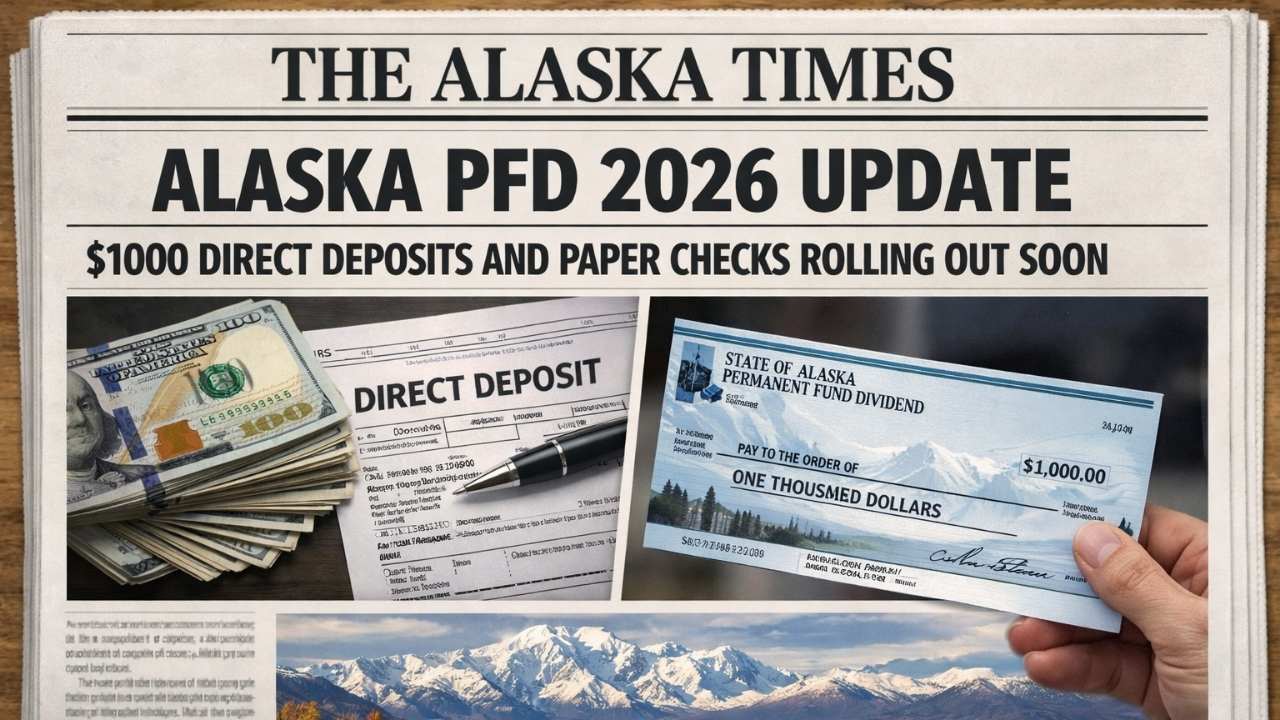
Alaska PFD 2026: Alaska residents are beginning to see $1,000 payments hit their bank accounts as the latest Permanent Fund Dividend distributions move forward. For many households, this annual payout provides a timely financial boost early in the year.
Unlike federal stimulus programs, the PFD is a state-managed dividend funded by Alaska’s oil revenue investments. Each eligible resident receives the same base amount once approved.
Also Read: Who Qualifies for the $147 Cash App Settlement Payout and When $12.5 Million Payments Arrive
Here’s what’s happening with the 2026 rollout, who qualifies, and when to expect your payment.
What Is the Alaska Permanent Fund Dividend?
The Alaska Permanent Fund Dividend program distributes a share of the state’s oil and mineral revenue earnings to residents each year. The fund itself was established to invest resource revenue for long-term benefit.
Every year, the payout amount depends on state revenue performance and legislative decisions. For the current distribution cycle, the approved dividend amount is $1,000 per eligible resident.
Also Read: December 2026 Payment of $1,776 Confirmed Tax-Free by IRS for 1.5 Million Military Members
This payment is not income-based. Eligibility depends primarily on residency requirements and compliance with state rules.
2026 Payment Schedule Overview
Payments are being issued in phases throughout early 2026. Applicants whose status shows “Eligible-Not Paid” by specific cutoff dates are included in the next scheduled distribution.
Direct deposits are typically released first. Paper checks follow shortly after for residents who selected that option or did not provide banking information.
Processing timelines vary depending on when your application was approved. Those approved earlier in the cycle generally receive funds sooner.
Checking your application status through the state’s official PFD portal remains the most accurate way to confirm where you stand.
Direct Deposit vs. Paper Checks
Choosing direct deposit significantly speeds up delivery. Once released, electronic transfers usually appear in bank accounts within a few business days.
Also Read: IRS Information Return Penalties 2026: Understanding The $680 Per Form Risk
Paper checks take longer due to mailing and postal delivery times. Weather conditions and rural addresses can sometimes add extra delays.
Incorrect banking details may also trigger a switch from direct deposit to a mailed check. That change can extend your wait time.
Residents who recently changed banks should verify that their updated information is correctly reflected in their PFD account.
Who Qualifies for the $1,000 Payment?
Eligibility centers on Alaska residency. Applicants must have lived in the state for the entire qualifying year and intend to remain residents.
Claiming residency elsewhere can disqualify an applicant. Extended absences outside Alaska may also affect qualification.
Certain criminal convictions or incarceration periods can impact eligibility as well.
Also Read: How the 2.8% Social Security Raise 2026 Impacts $2,071 Average Retirement Benefits Nationwide
Each applicant must submit a completed application during the annual filing window, which runs from January through March.
Missing the deadline typically means waiting until the next dividend cycle.
Why the Amount Is $1,000 This Year
The dividend amount changes annually based on available earnings and state budget decisions. In some years, payouts have been higher.
Also Read: Smart Retirement Planning: 5 Proven Social Security Moves To Maximize $50,000 In Extra Income
For this cycle, lawmakers approved a $1,000 distribution per eligible resident.
Budget balancing, oil market performance, and investment returns all play a role in determining the final figure.
Even at $1,000, the dividend remains meaningful for many families, especially those in rural communities where costs can be higher.
Also Read: WIC Program 2026 Offers $52 Monthly Fruit and Vegetable Benefits
How the Approval Process Works
After you apply, the state reviews residency records and supporting documentation. Applications may remain in “Under Review” status until verification is complete.
Once approved, the status changes to “Eligible-Not Paid.” At that point, your payment is queued for the next scheduled distribution date.
If documentation is missing, the state may request additional information. Prompt responses help avoid further delays.
Also Read: First-Time Home Buyer Grants 2026 Update: With $25,000 Down Payment Assistance Explained Clearly
Applicants who are denied have the option to appeal within a specified timeframe.
Common Reasons for Delayed Payments
Incomplete applications often slow processing. Missing signatures or outdated contact information can require follow-up.
Residency questions sometimes require manual review, especially if the applicant spent extended time outside the state.
Also Read: IRS Refund Schedule 2026 Updated: Average $2290 Payments Rise 11% Despite 12.3% Filing Drop
Banking errors also cause setbacks. An incorrect routing number can force the state to cancel a direct deposit and issue a paper check instead.
Name mismatches between the application and bank account may trigger additional verification steps.
Keeping personal records accurate reduces the likelihood of these complications.
Also Read: New Child Tax Credit 2026 Amount, Income Limits, And Refund Rules Fully Explained
Is the 2026 Dividend the Same as a Stimulus Check?
Some confusion arises because both involve direct payments. However, the Alaska PFD is entirely separate from federal stimulus programs.
The dividend is funded by state investment earnings, not federal tax revenue.
Every eligible resident receives the same base amount regardless of income level.
Also Read: Millions Could Receive $200 Monthly Social Security Boost Under New 2026 Bill
Federal stimulus checks, by contrast, typically include income thresholds and national economic triggers.
Understanding that distinction helps clarify why Alaska residents receive these payments annually.
What Happens Next?
Applications for the next dividend cycle are already underway. Residents must submit their forms during the designated filing period to qualify for future payments.
Also Read: IRS Payments February 2026 Explained: Stimulus Check Rumors, Tax Refund Dates, and Real Updates
The amount for the upcoming cycle has not yet been finalized. That figure will depend on legislative decisions and investment performance later in the year.
Staying informed through official state channels ensures you receive accurate updates.
Final Thoughts
The $1,000 Alaska PFD payments are now rolling out across the state through direct deposits and mailed checks. If your application has been approved, your funds should arrive according to the published distribution schedule.
Also Read: 2026 Federal Pay Raise Confirmed With 1% GS Base Increase and Locality Pay Freeze
Verifying your status online and ensuring your personal information is current can prevent unnecessary delays.
For thousands of Alaskans, this annual dividend continues to provide steady financial support as 2026 gets underway.
Also Read: IRS February 2026 Refund Schedule What Taxpayers Should Expect This Filing Season

Dr Linda Steele is a Senior Lecturer at the Faculty of Law, University of Technology Sydney, and a member of the Law Health Justice Research Centre. She is also a Visiting Senior Fellow at the Faculty of Law, Humanities and the Arts, University of Wollongong.