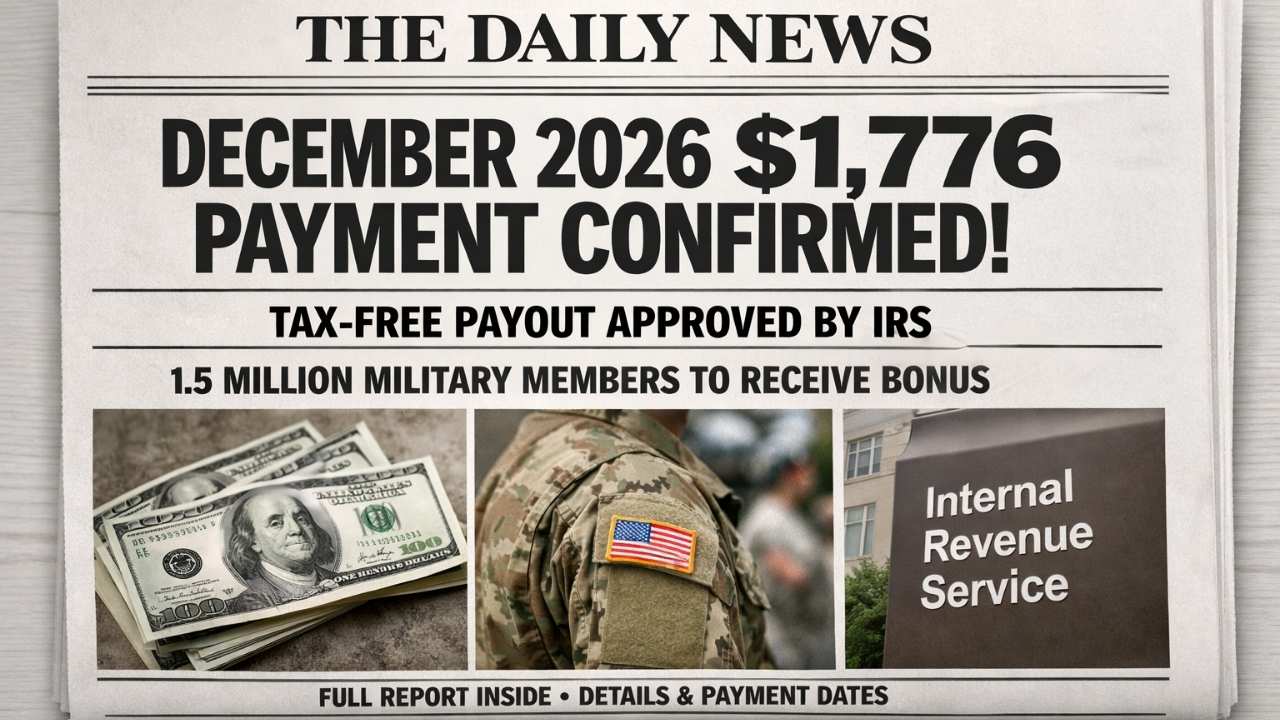
December 2026 Payment: In a move that drew widespread attention last winter, the Internal Revenue Service has officially confirmed that a one-time payment of $1,776 issued to roughly 1.45 million to 1.5 million active-duty U.S. military members in December 2025 is considered tax-free. The confirmation clarifies confusion that had circulated about how the payment should be treated for federal income tax purposes.
The payment was distributed through regular military payroll channels toward the end of 2025, and recipients received the amount in their pay accounts like any other pay deposit. Defense officials characterized it as a supplemental payment tied to military compensation rules, and the IRS later issued guidance stating that the payment does not count as taxable income for federal tax filing.
Also Read: Who Qualifies for the $147 Cash App Settlement Payout and When $12.5 Million Payments Arrive
Under long-standing federal tax law, certain types of military pay especially those tied to allowances, duty status, and specific benefits are not subject to federal income tax. The IRS’s guidance makes clear that the $1,776 payment falls into this category, meaning service members will not be required to include the amount on their 2025 federal tax returns. For most recipients, that effectively means the full amount stays in their hands without any federal withholding.
Who Received the Payment and Why It Matters
The distribution was aimed at active-duty personnel and certain eligible reserve forces who met criteria tied to service duration and duty status. Most recipients were those serving full-time under federal orders, with eligibility tied to service dates prior to the end of November 2025. Members from all branches Army, Navy, Air Force, Marine Corps, Space Force, and Coast Guard were included as long as they met the specified requirements.
Officials explained the payment as an additional compensation benefit rather than a standard salary increase or bonus. This distinction became important when the IRS weighed in: the rules that govern tax exclusion for military pay, including allowances and certain special compensations, allowed the agency to classify the payment as nontaxable. That distinction is significant for tax planning, especially for service members with complex income situations.
The confirmation from the IRS also eased concern among taxpayers who feared that the payment might complicate their tax returns or trigger an unexpected tax bill. By clarifying that the money is not reported as taxable wages, the IRS has reduced that uncertainty heading into the 2026 filing season.
How the Tax Treatment Works
Federal income tax rules on military compensation have long recognized that some forms of pay and allowance are exempt from taxation. Examples include housing allowances and hazard pay earned in designated areas. While the $1,776 payment drew public attention because of its round figure and the timing of its distribution, its tax treatment aligns with those existing classifications.
Because the payment is excluded from taxable income, it does not raise adjusted gross income for federal filing purposes. That means it does not affect tax credits or deductions that are tied to federal adjusted gross income. Service members can file their 2025 federal tax returns without listing the payment as taxable income or worrying about additional tax liability.
Also Read: Alaska PFD 2026 Update: $1000 Direct Deposits and Paper Checks Rolling Out Soon
The IRS’s clarification also helps ensure that payroll systems and tax documents reflect the correct treatment. Finance offices within military commands have been advising service members to check that pay records properly indicate the nontaxable status. In cases where statements initially showed it as regular wages, corrections are expected to follow standard payroll adjustment procedures.
What Military Members Should Know Now
For members who received the December payment, there’s no additional tax action required on the federal level. The IRS has confirmed that the $1,776 does not need to be included in taxable income, and most service members will not see any impact on the forms they receive for 2025 tax filing.
However, it’s still important for individuals to watch their year-end pay documents and consult with their base finance offices or tax assistance resources if anything appears incorrectly reported. Issues like missing or mischaracterized income entries are common in payroll systems and can usually be resolved before filing.
Also Read: IRS Information Return Penalties 2026: Understanding The $680 Per Form Risk
Service members with additional income sources or complicated tax situations such as rental earnings, investment income, or civilian wages may choose to get personal tax guidance, but the tax-free status of this specific payment should simplify federal filing for most.
Broader Financial Impact
The confirmation of tax exclusion underscores how military pay and benefit rules interact with federal tax law. For the roughly 1.5 million service members who received the payment last December, the assurance that it is tax-free increases its practical value.
While the payment itself was modest relative to annual compensation, the full, untaxed amount represents a meaningful addition for many households. Service members often juggle relocation budgets, family living costs, and deployment-related expenses, and an untaxed payment of this size can help in areas like emergency savings or year-end financial planning.
With the IRS guidance now public and widely covered by tax and military financial experts, service members can proceed into the 2026 tax filing season with clarity about how this payment fits into their federal income picture.

Dr Linda Steele is a Senior Lecturer at the Faculty of Law, University of Technology Sydney, and a member of the Law Health Justice Research Centre. She is also a Visiting Senior Fellow at the Faculty of Law, Humanities and the Arts, University of Wollongong.